Friday, February 18, 2011

Laying the groundwork for reform...

Yesterday, I had the honor of representing the CPSC as a witness before the House of Representatives Subcommittee on Commerce, Manufacturing and Trade. The hearing, entitled “Review of CPSIA and CPSC Resources,” afforded me the opportunity to testify about the unintended consequences of the CPSIA. We can all agree that the original intent of the CPSIA was an admirable one, however, given the massive impact of the law’s testing and certification requirements and the overreach of the Commission’s database regulation, it is now in the hands of Congress to prevent further disastrous, economic consequences. This hearing provided Congress with the opportunity to discuss these key issues.

In my prepared testimony, I argued for two actions that Congress could take immediately to ameliorate the consequences of the CPSIA and two long-term reforms to ensure that harmless products are not caught up in the law’s purview. Immediate recommendations include:

- Prohibiting the launch of the new database until the Commission’s regulations ensure that the information contained in a report of harm is verifiable, and the Commission has established an effective procedure for resolving a claim of material inaccuracy before a report of harm is put on the Database.

- Prohibiting the Commission from undertaking any further regulatory action without first performing a full cost-benefit analysis and making a finding that the cost of the action is justified by its expected benefits. (This would impact accrediting labs to test to the phthalate or toy standards, the 15-month rule, etc.)


Two long-term proposals for reform include

- Amending the law’s absorbability exclusion § 101(b)(1) so that it has meaning. Such a change would result in excluding products or materials with a level of absorbable lead that the Commission determines not to be harmful to a child’s health.

- Eliminating third-party testing, certification and tracking labels of all children’s products, allowing the Commission to retain its authority to impose such requirements only where necessary to address a risk.

These changes will provide much needed relief to small businesses throughout our country. Further, I believe that by doing this, we can ensure that the CPSC will continue to use the tax dollars afforded to us by hard working Americans in a meaningful way, rather than on enforcing standards and paperwork requirements entirely unrelated to risk.

In the hearing's second panel, Members of Congress were able to receive testimony from several of the small businesses that I hear from on a regular basis. These individuals provided firsthand accounts about the effects that our rulemaking is having on their futures.

I am hopeful that moving forward, Congress will take my testimony and the testimony of the witnesses into account in crafting a reform bill.

Click here to view yesterday’s webcast: http://energycommerce.edgeboss.net/wmedia/energycommerce/SCCMT021711.wvx

Tuesday, February 1, 2011

Staying Power

Last night, the Commission voted 4-1 to extend the stay of enforcement on testing and certification to the lead content standard until December 31, 2011. I am pleased that the Commissioners were willing to compromise on this extension.

While I welcome this decision, I continue to believe that the stay of enforcement should remain in place until one year after the finalization of the Commission’s rulemaking on both Testing and Labeling Pertaining to Product Certification and Conditions and Requirements for Testing Component Parts of Consumer Products. After all, the Commission has broadcast to the regulated community since 2009 its commitment to allow component parts testing and certification to become a viable compliance alternative for manufacturers before third party testing and certification for lead content in most children’s products becomes mandatory.

Over the past several weeks, large and small businesses throughout the country who would have been affected by this decision, have been in contact with my office urging a stay of this testing requirement, particularly since the Commission’s testing regulations have not been finalized. In the absence of those final rules, component suppliers are refusing to test altogether or are refusing to supply certifications. In addition, certifications are unavailable from the retail outlets where many small manufacturers obtain component parts.

I believe that third party testing imposes a financial burden that many manufacturers, and particularly small ones, may never be able to bear. But if there is any hope for their survival, it is essential that the stay not be lifted before there is at least an opportunity for certified component parts to form the basis for the final product certifications of small manufacturers.

If you are interested in learning more about the effects of this decision, please read my official statement for more information.

Please know how much I appreciate all the feedback and information that has been provided to my office over the past few weeks on this topic. This decision was an important victory for businesses both large and small throughout the country. I recognize that this could not have been achieved without your input. As always, if you have any questions or comments, please do not hesitate to contact me at commissioner_northup@cpsc.gov.

Friday, January 21, 2011

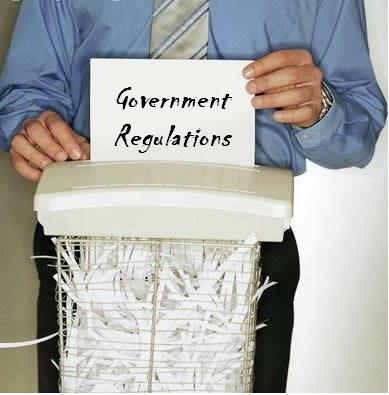
Shredding the excess

On January 18, 2011 President Obama issued an Executive Order that expressed his desire to eliminate rules that “stifle job creation and make our economy less competitive.” It should come as no surprise that companies and businesses are continuing to face the burden of government regulation and the challenge of providing opportunities and work for individuals throughout the country. In his recent op-ed, President Obama notes that government agencies need to “make sure we avoid excessive, inconsistent, and redundant regulation.”

As a Commissioner of an independent regulatory agency, I want to know how the CPSC can make this initiative a reality. I invite you to tell me which regulations have been costly to your organization or caused greater inefficiency, where there is very little safety enhancement to be derived. I want to know which rules or regulations your company is worried about, so that together we can move forward in creating jobs while also ensuring safety.

Over the next few weeks, and in the spirit of President Obama’s recent Order, I look forward to sharing with you some of the simple changes that I believe would go a long way in making a significant impact in achieving this goal. In addition, I look forward to receiving your examples and input about ways in which we can move the CPSC in the right direction.

Friday, January 14, 2011

In case you missed it...

This week, the Washington Post had a front-page article on the looming public database, including a balanced look at industry’s concerns. I did contact the reporter to clarify one key issue:

The article reads, “If a company says a complaint is false or would disclose confidential business information, the CPSC will decide whether to withhold or publish the complaint.” Well…not exactly. Unfortunately, the reporter was led to believe that the agency would be able to resolve all reports of material inaccuracy within the 10 period time period. This is completely unlikely.

On the contrary, the Commission has decided not to exercise any discretion and to go ahead and put up claims even where there is a material inaccuracy claim pending past 10 days. For example, if a manufacturer knows that the product in question is not theirs and files such a claim on the 9th day , it is highly unlikely that the Commission will even be able to resolve the claim by the end of the 10th day (let alone any other pending claims that week)—resulting in the inaccurate report still going up on the database.

And you guessed it—inaccurate information about a manufacturer or their product on a “.gov” database is not only detrimental to the manufacturer, but it is useless to consumers using the database.…

Tuesday, November 30, 2010

Wednesday, November 24, 2010

Database: Setting the Record Straight

Last week, the Los Angeles Times published an article that did not present fully all of the facts on the Majority’s consumer database proposal. To set the record straight, I submitted the following letter to the editor, which was published in today's paper:

Review rules

Re "Whose concerns will make the cut?" Business, Nov. 16 David Lazarus gives the impression that all reports in the Consumer Product Safety Commission's public-backed database will be vetted. Here are the facts: The commission's proposal includes no requirement that reports of harm submitted to the database be verified for accuracy before they are posted. If a manufacturer claims that a report is inaccurate, there is no requirement or even incentive for the commission to review or make a determination on such claims. To make the database more reliable for consumers, I have proposed an alternative rule that improves on these areas; I hope my fellow commissioners will consider it. Without such changes, the commission's saferproducts.gov database will be useless to the very consumers the commission claims to be helping.

Anne M. Northup
Bethesda, Md.

The writer is a commissioner on the U.S. Consumer Product Safety Commission.

Here is the link to letters to the editor: http://www.latimes.com/news/opinion/letters/

Here is the link to last week's article: http://www.latimes.com/business/la-fi-lazarus-20101116,0,835664.column

Tuesday, November 9, 2010

WE INTERRUPT THIS PROGRAM…WITH AN ALTERNATIVE

Given the many flaws of the Commission’s draft final rule for the public database, my colleague, Commissioner Nord, and I have proposed an ALTERNATIVE DATABASE RULE. This rule more accurately reflects the law Congress provided us and it will address some of its key flaws.

Our alternative rule will:
- tighten up who can submit information so that the reports coming into the database are more reliable;
- improve the procedures for correcting inaccurate information so that consumers are not misled by bad information in the database; and
- put in place procedures for review of reports so that the database does not become a “post it and forget it” exercise.

There is still time for the Commission to make these changes since the database vote is not until November 17th. I hope this alternative will receive due consideration.

More details to come on the Database rule’s main flaws…

Click here for Commissioner Nancy Nord's blog post regarding our alternative